True Thanksgiving

The prayers and good wishes I received on the occasion of my nomination and blessing as abbot were truly overwhelming. I wish everyone could have a similar experience. When so many people think of you, send you good thoughts, and pray for you, it gives you incredible strength and support. Ultimately, this support comes from God, but it is conveyed through people, through friends. What if we could do this more often, pray for each other together?

At the same time, I felt the need to thank God and people. I felt that so much had been given to me personally and to my community that words cannot express this gratitude. Nothing can equal what I owe to God and the people who prayed for us. In this respect, the liturgy helps enormously. The Psalms help because they express what we cannot find words for. Many of them speak of the goodness of the Lord and sing of gratitude. They speak of sacrifices of praise and thanksgiving.

Nevertheless, I felt guilty because I did not sense that I was responding appropriately to what I had received. My ego was simply too small to take it all in, and too small to praise God and thank him for everything. But there was one consolation: that is why Jesus Christ came into the world. He is the true thanksgiving for us. He is the spotless sacrifice to God. Since we humans were unable to give God what we owed him, he sent his Son, who, as both man and God, was able to “give back” what was necessary, with his entire life. He redeemed what needed to be redeemed. This happens in the Holy Eucharist. Eucharist means “thanksgiving.” Jesus gives himself to the Father for us. Because our sacrifices and our thanks are not great enough, not pure enough, not adequate enough—they never will be, they will never suffice—he does it for us. He expects nothing in return. Only that we remember him and celebrate it: “Do this in memory of me.”

Dear Lord, there is so much for which we can be thankful. We have received so much from you. How wonderful it is that you pray for us. You are the true high priest. God, your Father, has accepted your sacrifice of thanksgiving. We are now reconciled with you. We no longer need to feel guilty. Your pure grace has given us all this. And it continues to do so.
What can I offer personally?

At the center of the Holy Eucharist is the offertory. What can I offer? I can certainly give money in the collection. But the offertory invites us to go deeper. Just as Christ offers himself, I am invited to give myself as well. I can offer myself, personally.

It is not difficult. I can offer my gratitude, as Psalm 116:17 suggests, “I will offer a sacrifice of praise.” I can offer, in some way, who I am at this moment. My situation. And how I am feeling. Nothing is too small to offer to Jesus. Whatever I perceive in myself, Jesus wants to hear it, and he wants to accept it as my offering. Even if I feel like it’s not enough or it’s too ugly – it can become my offering that He wants to transform.

– I feel frustrated. I can offer my frustration.

– I feel fear. I put my fear on the altar.

– I am angry: I give my anger to Him.

– I am proud. I offer my pride to Him.

– I am in pain. I offer Him my pain.

– I am in despair. I offer Him my despair.

– I feel like I have nothing to give: I offer Him just that – my powerlessness, my inability to give Him anything.

Psalm 51 says: “For you do not desire sacrifice; I would give it to you. A burnt offering you would not accept. My sacrifice, O God, is a contrite spirit; a contrite, humbled heart, O God, you will not spurn.” (Psalm 51:18-19) When I give what I am, who I am, who I am at this moment, I give enough — and He will accept this as a gift and transform me. It is the humble heart that He accepts.

Lord, let me be awake at the moment of the offering. Let me give myself and hold nothing back. Look at my gift with your kind eyes. Accept me. Lift my soul to You as You lifted Your beloved Son. So let me leave the Eucharist relieved, lighter, more joyful, and filled with Your love.

There Is Blood

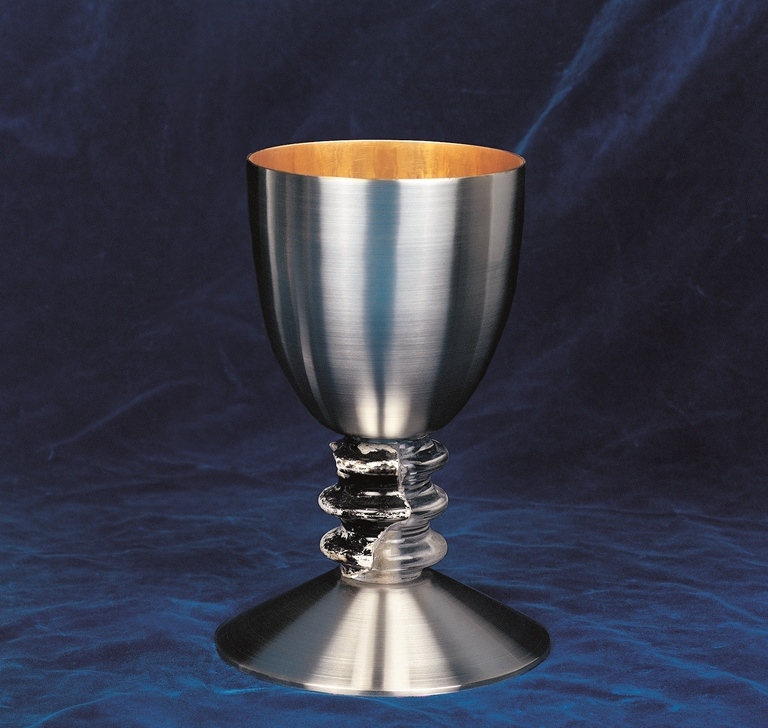
Kelch_Mauritius Wilde

When I became a priest, I had the longing to never get used to what I was going to do. My chalice should help to remind me. Years before my ordination I had been in Auschwitz. I could hardly bear what one is confronted with at this place of suffering. I retired a bit from the crowds and–kneeling on the ground–my fingers played in the soil, and unexpectedly found an isolator. It had probably served on one of the deadly fences around the camp. Having it in my hands, I immediately thought this piece could become the node of my chalice. – Years later, shortly before my ordination, I carried the isolator to the goldsmith of our monastery and he was able to create a chalice out of it. The broken piece is now completed with mountain crystal as sign that God heals what is broken, in life, and especially during the Holy Eucharist. God completes what is not finished, He takes the broken and heals it. He does so by the shedding of the blood of his own Son.

I am trying to imagine how much suffering, pain, and injustice this isolator “has seen”. It is a witness of the injustice that cried out to heaven, of the blood that was shed innocently. Also, Jesus was killed innocently. We believe that during the Holy Eucharist the wine is changed into the blood of Christ. We should not forget: what we have on the altar and what we receive is blood. When we lift the chalice towards heaven, we are reminded that God heard the cry of his Son. He came to take the sins away. The liturgy is not just a nice spectacle. It is about life and death. It celebrates that life prevails. That the dead will be raised. Jesus himself suffered and was killed. But he was raised from the dead and is alive now, with God. This is my prayer for all who died in the concentration camps. It is my prayer, with each Eucharist, that wounds are healed, especially those of the generations of families whose loved ones died in the Holocaust.

It does not take much to see in this chalice also the suffering of today’s times. There are enough people who suffer; who are afraid; who are oppressed; who are sick and don’t get help; who are treated unjustly; who are sidelined; who are persecuted; who are kidnapped; who are killed. Unfortunately, the suffering on earth did not find an end after Jesus’s death; although he wants us to live according to the new rules of the Kingdom of God. At least–that gives me hope–God looks at the suffering of his people. And, finally, he will bring everything to a good end.

Lord, in silence we stand before you holding the suffering of our world and our own suffering up to heaven. Look on us in your mercy. Look at the blood of your Son. Let us not become too tired to cry out to you, to celebrate your Son’s death and resurrection, to celebrate the drama of his life and the new hope you have given us.