Without hope – what will the end look like ?

I recently met a woman in her early 60s who shared with me her concerns about political developments and the future. In view of the uncertainties of our time, her conclusion was: enjoy every day, make as much of it as you can while you are healthy, invest in your health and take each day as it comes. Then we talked about aging and the fact that as we get old, we may need care and assistance, some day. Two factors cloud this prospect: demographics – at least in some countries. Who will take care of us? There will be many more old people than young ones. We cannot expect our children to take care of us if they can at all. The other factor is certainly money: care will become more expensive, and our lives will be longer compared to previous generations. And then the woman said something to me that shocked me: if necessary, one would have to give dying a helping hand. I have heard this argument more often recently. There are countries where euthanasia has become more accepted and common, for example in Switzerland and the Netherlands. As much as life is endangered at the beginning, so it is now at its end.

If life is just consuming, enjoying, making the most of our days, one consequently will stop it when this objective cannot be fulfilled anymore. As I listened to this woman, I wondered how I would react in such a situation. There are already phases of suffering or pain in earlier years that, seen from this perspective, would not be worth living. What helped me during these phases? Prayer. The Eucharist. The conversation with God, to whom I can entrust all my thoughts and feelings. People who walk with me and hope with me. I wonder how this life can be bearable without faith, especially in difficult days. To be honest, I am not free of concerns about the future, but I hope that God, who gave me this life, will take care of me. With His help, I and we will find ways to live a dignified life until the day it ends. I realized once again how precious our faith is and how it changes our outlook on life.

Lord, let your angels be near all old people. Let them be cared for. Bless their lives, even when they no longer seem to have any meaning. Let us stand with respect for the suffering that an old person must endure. Who understood Your suffering on the cross when you were going through it, Lord? No one. And did it make sense in the end? More than make sense. My Lord, take away my fear. Let me never give up hope, for my life, for this world. Your future is not dark. Let me enjoy each day gratefully, with you. It is all grace.

Whatever you do with love

Sometimes we are not successful. Sometimes we have done things in vain. Sometimes we have put a lot of effort in something, but it did not turn out the way we wanted. There are many things that can interfere, the weather, stupid accidents, our health. Often it is the people who don’t go along what we had aimed for, our bosses, our colleagues. Sometimes it is the evil one who crosses out our plans. At times, it’s just ouselves who are too weak.

Our reaction to all of this is crucial. A first response could be immediate frustration, anger, even depression. And the question is: Why? Why not? Why me? The only salvation in these moments is to detach from the situation and try to look from the point of view of God. What would He say? What will he say, when he comes again? He will not only and not necessarily look at the outcome of our deeds, efforts, and dreams, he will look how we did all of this. Did we do it with love? Whatever we have done with love cannot have been in vain. Our love in itself was worth it. Even if people don’t see it, even if the fruit does not show, we acted out of the right motivation. A love you have spent for somebody or for a group has always an effect, even if it cannot be seen, yet.

We could approach our daily life in this way. It is enough if we do what we do with love. It will change me, it will change the world. “Faith, hope, love remain, these three; but the greatest of these is love,” says St. Paul (1 Cor 13:13). These three are never given in vain. If this would not be the case, the life, the passion, and the death of Jesus would have been totally without any sense. His mission ended without success. But because it was done out of love for his father, out of love for his brothers and sisters, his mission finally reached its goal, until today. If we follow him in these manner, our life will make sense, no matter what happens.

Lord, let me work to love more, every day. Let not a single day go by without a good deed done out of love, a faithfulness motivated by love, a creativity inspired by love. You are love, and I thank you that you love me. Help me not to forget to love myself. Come, o Holy Spirit of love!

Hot-Cold, Bumpy-Smooth, Risky-Safe

We freeze vanilla ice cream. We heat raspberries. And then we put the ice-cold cream and the hot fruit together and eat them! We do strange things. There used to be a bumpy gravel road behind our monastery school. We spent a lot of money to asphalt it. But because people were driving too fast on the beautiful road, we put speed bumps on it. Now the cars drive in a slalom. Life is interesting. People take off their clothes. And then they apply sunscreen to protect their skin. That’s understandable: we want to get a tan, we want to avoid the dust on the road, and we love to enjoy ice cream and hot raspberries. But if you look at it closely, it’s all a bit strange.

Sometimes our heart, our soul is the same. Things don’t go well together. Things do not harmonize at first glance. Things in our inner life are contradictory. I want one thing and do another, says St. Paul (cf. Rom 7:19). We try to tidy up our soul, but it seems to be even messier. I don’t understand myself. But when I look at life in general: life is hot-cold, bumpy-smooth, risky-safe. Why should my inner life be any different? But what really gives me comfort is the belief that God sees me as I am. That he knows me. That he puts together what doesn’t seem to fit together. That he loves me, even in my ambiguity. When I know this, I don’t have to run away from myself and can face who I am and how I am. As it says in Psalm 139:

Lord, you have searched me, you know me:
Where can I go from your spirit?
    From your presence, where can I flee?
If I ascend to the heavens, you are there;
    if I lie down in Sheol, there you are.
If I take the wings of dawn
    and dwell beyond the sea,
Even there your hand guides me,
    your right hand holds me fast.
If I say, “Surely darkness shall hide me,
    and night shall be my light”
Darkness is not dark for you,
    and night shines as the day.
    Darkness and light are but one.
You formed my inmost being;
    you knit me in my mother’s womb.
I praise you, because I am wonderfully made;
    wonderful are your works!
    My very self you know.

God sees everything. He holds me firmly. He guides me along the way, even when I take detours; in his eyes everything will be fine. I thank him with awe: 

How precious to me are your designs, O God;
    how vast the sum of them!

Auguste Rodin: Hand of God


There Is Blood

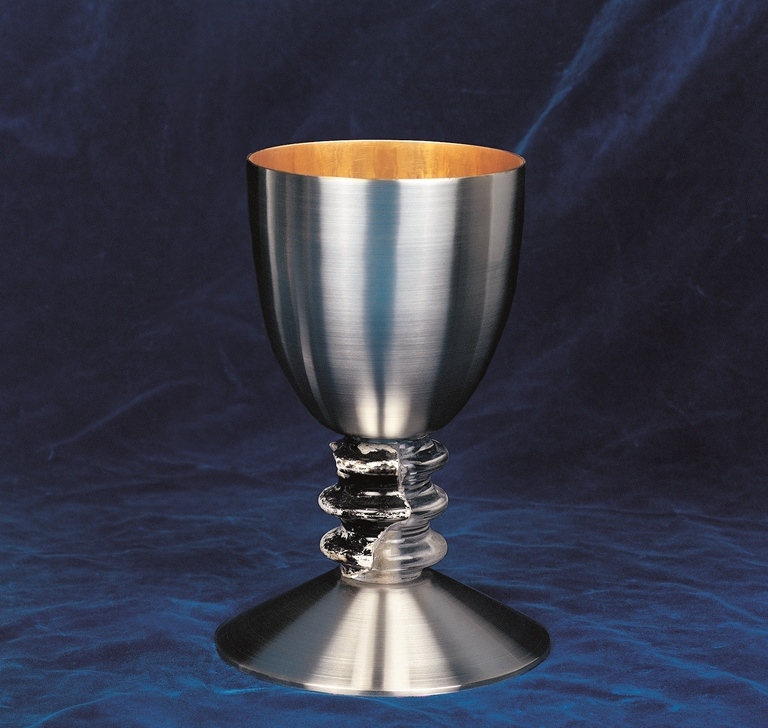
Kelch_Mauritius Wilde

When I became a priest, I had the longing to never get used to what I was going to do. My chalice should help to remind me. Years before my ordination I had been in Auschwitz. I could hardly bear what one is confronted with at this place of suffering. I retired a bit from the crowds and–kneeling on the ground–my fingers played in the soil, and unexpectedly found an isolator. It had probably served on one of the deadly fences around the camp. Having it in my hands, I immediately thought this piece could become the node of my chalice. – Years later, shortly before my ordination, I carried the isolator to the goldsmith of our monastery and he was able to create a chalice out of it. The broken piece is now completed with mountain crystal as sign that God heals what is broken, in life, and especially during the Holy Eucharist. God completes what is not finished, He takes the broken and heals it. He does so by the shedding of the blood of his own Son.

I am trying to imagine how much suffering, pain, and injustice this isolator “has seen”. It is a witness of the injustice that cried out to heaven, of the blood that was shed innocently. Also, Jesus was killed innocently. We believe that during the Holy Eucharist the wine is changed into the blood of Christ. We should not forget: what we have on the altar and what we receive is blood. When we lift the chalice towards heaven, we are reminded that God heard the cry of his Son. He came to take the sins away. The liturgy is not just a nice spectacle. It is about life and death. It celebrates that life prevails. That the dead will be raised. Jesus himself suffered and was killed. But he was raised from the dead and is alive now, with God. This is my prayer for all who died in the concentration camps. It is my prayer, with each Eucharist, that wounds are healed, especially those of the generations of families whose loved ones died in the Holocaust.

It does not take much to see in this chalice also the suffering of today’s times. There are enough people who suffer; who are afraid; who are oppressed; who are sick and don’t get help; who are treated unjustly; who are sidelined; who are persecuted; who are kidnapped; who are killed. Unfortunately, the suffering on earth did not find an end after Jesus’s death; although he wants us to live according to the new rules of the Kingdom of God. At least–that gives me hope–God looks at the suffering of his people. And, finally, he will bring everything to a good end.

Lord, in silence we stand before you holding the suffering of our world and our own suffering up to heaven. Look on us in your mercy. Look at the blood of your Son. Let us not become too tired to cry out to you, to celebrate your Son’s death and resurrection, to celebrate the drama of his life and the new hope you have given us.