Believe that you are loved

Sometimes we feel that there is not enough love in our lives. We think that our spouse, our confrere, our fellow human being, could love us more. God could love us even more. Our desire for love is so deep and comprehensive that it is hardly possible to satisfy it completely. We should not feel guilty about this longing. That is simply how we are made. Why is that? Because God created us that way. He created us out of love and out of an abundance of love. Out of pure love. We want to feel that at all times, to live out of that love. When a little bit of that love is missing, we feel it too.

Years ago, my novice master told me something I have never forgotten. Even if someone loves you, you still have to believe that he or she loves you. Even if he gives you all the signs of his love, a letter, a kiss, a gift, even a sacrifice—if you don’t believe that he loves you, it would be in vain. That is a leap we have to take: to believe it. And to accept it. Sometimes we live in disharmony with other people, believing that they do not wish us well, perhaps even wishing us harm. And perhaps we are right in this perception. But there is always a certain amount of love. Parents, for example, loved us even if they were unable to express their love for us adequately and fully. And perhaps years later, even after their death, we can recognize this and finally accept it.

God loved the world so much that he sent his only Son (John 3:16). And we did not accept him. And we did not believe him. We did not believe in God’s love, even though we saw it. Was his love for us still real? Of course it was! It took many people to believe and accept it. Mary, the Mother of God, gave us an example how to believe in God’s love. God has made all of us for himself, and our heart is restless until it rests in him. (St Augustine) In the end, the love with which God surrounds and embraces us will be fully revealed. For love was there from the beginning, and so it will be there at the end.

Lord, I am grateful for your love. Let me believe in your love. Let me see the traces of love in my neighbor as well. Let us never see only the dark side. Give me humility to accept that I am loved, and let me put aside grumbling and resistance.

God Is Always Greater

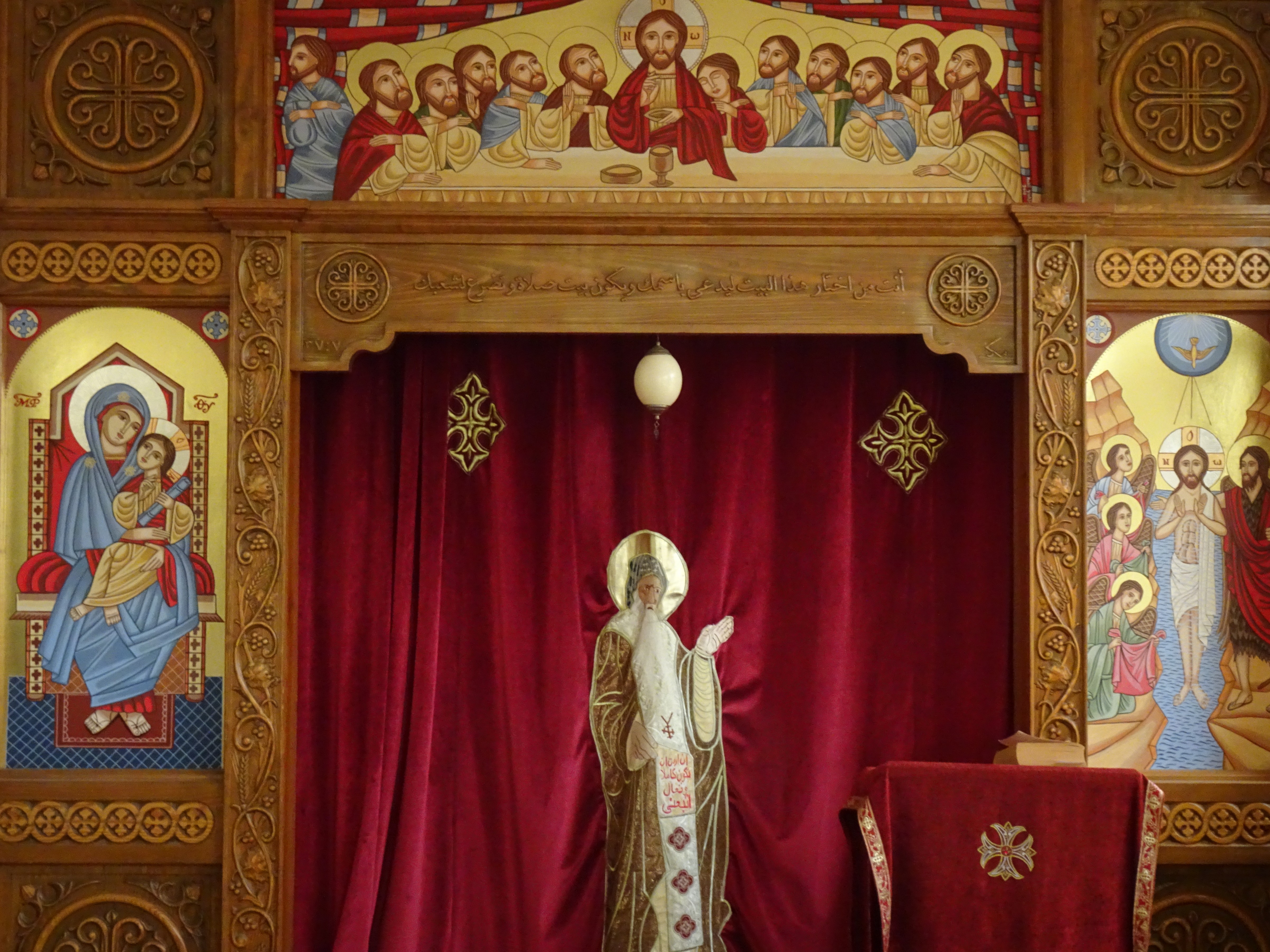
Since I had the gift of spending some time in Egypt with my brother monks in a Coptic Benedictine monastery, I was able to experience our prayer in a different environment. I stood and prayed in front of an iconostasis.

Normally, in our Latin-Western tradition, everything is open. You can see the altar. You can see the sanctuary. But this is not the case in the Eastern churches. The iconostasis blocks the view of the altar. There is a door or a curtain that can be opened for the Holy Eucharist. Otherwise, you are left standing in front of a wooden wall. This wall is called an iconostasis because it holds many icons.

The first time I prayed this way, I felt a strong impression: God is great. He is always greater than I can ever imagine. You are practically standing before the Unknown. Of course, the icons help you understand and enter into the mystery. Mary, the Mother of God, is there with the child. John the Baptist is present, along with the apostles and other saints. But you realize immediately: these are only “images.” I am aware that, in the Orthodox tradition, an icon is more than just an image. It is a representation of the Holy. But for me, it was liberating to feel that all that I can see, all that I can know, all that I can dream, all that I can fear, all that I can understand, all that I can long for, never fully coincides with who God really is. His greatness is beyond all of it – as the altar here is beyond the curtain.

Getting in touch with His mystery was liberating, freeing. And – unexpectedly – it left me with more hope, more courage, more desire to seek God in my daily life. And isn’t that the truth? We don’t know what tomorrow will bring. Acknowledging that is the best way to live the present.


My God, you are great and wonderful. The saints show us the way. Your only Son Jesus Christ IS the way to you. Help me to let go of all my ideas. Help me to throw myself into the unknown, to throw myself into your wide-open arms. Forgive me this imagination.

The Divine Hunter

In the former Benedictine monastery of Benediktbeuern in Germany, there is a painting from the 17th century that shows Jesus as a hunter. It is a rather unusual image of Jesus. We see him as a fairly young man holding a rifle in his hands and shooting at some wild animals. Next to him are three women who allegorically embody faith, hope and love. In the background, four people can be seen in the context of a driven hunt, representing the continents known at the time. There is a fence in the foreground of the picture, making it clear that there is hardly any way out for the animals. The animals themselves – an elephant, a deer, a fox, a lion, a crocodile and a leopard – are beautifully depicted. What could be the meaning of this painting?

The surrounding baroque paintings, also on the ceiling of the monastery hall, tell of Jesus as the one who catches souls. They depict Jesus as fisherman, for example. In fact, Jesus called St. Peter to fish for souls. The hunt for souls, on the other hand, is a rather unusual motif, but one that can be found in the Christian tradition. This image of Jesus perhaps does not correspond to the image we have of him as a peaceful, compassionate and tender person. Nevertheless, it appeals to me because of the energy it implies. You can see the fire as Jesus shoots. He actually came to baptize with Holy Spirit and fire (Luke 3:16). Sure, for many souls he may have to wait patiently, like a fisherman sitting on the shore or in his boat. Here, however, the divine hunter is most active. He is on the hunt for souls. He really wants to hit them. The fact that he is surrounded by the three virtues shows that it is not about destroying animals or metaphorically souls or even killing people. On the contrary – it is about winning them. Some people need to be hunted. Does that appeal to you? St. Paul was one of them: He, who persecuted the Christians, had to be chased by the Lord himself, had to be thrown from his horse to catch him. Jesus wanted Paul as he was, with this potential, even with his aggressiveness, and to channel this energy in the right direction. God knew that it was not easy to catch Paul, because there was a lot of resistance on his part.

Lord, search me when I want to hide. Chase me, pursue me when I try to flee, shoot me – my heart will be wounded, but that will give me new life, indestructible life. It will enable me to be life-giving myself, as you were, dear Jesus. Don’t give up on me until you have found me. And when you have hit me, help me to win other people for you, if it is your will.

Listening to the Soft Voice

Our brain is made to think. That’s why we have thoughts in our heads most of the time, sometimes non-stop, sometimes a little quieter. The monks, when they withdraw from the noisy outside world, learn to study the thoughts and voices in their minds. There are all kinds of thoughts. Good ones and bad ones. Those that come from God and bring peace, healing and joy, and those that do not come from God and bring confusion, negativity and ultimately destruction. Which voices are stronger? How do they sound? The prophet Elijah found out when he withdrew and took shelter in a cave:

“There was a strong and violent wind rending the mountains and crushing rocks before the Lord—but the Lord was not in the wind; after the wind, an earthquake—but the Lord was not in the earthquake; after the earthquake, fire—but the Lord was not in the fire; after the fire, a light silent sound.” (1 Kings 19:11-12)

The loudest thoughts in our heads are not necessarily the healthiest. Okay, when I’m hanging off a cliff and my head is screaming: Hold on so you don’t fall – a healthy voice. But often loud voices blame others, accuse others or ourselves, criticize, put down, make a wish that can’t be fulfilled at that moment – they are not helpful. It is good to let them die down or, if possible, to stop them. Strangely enough, it is precisely in such situations that God “sneaks in” with a quiet voice – as here with Elijah. It makes sense to get to know this soft voice.

Why does God speak with a quiet voice? He can also speak loudly, that is easy for him. But often he doesn’t – why? Perhaps he respects my freedom and doesn’t want to force me. He trusts that I can find the right thing. He is gentle. And merciful. Another reason could be that he wants us to really listen. Only when we hear the sound voice we become able to really listen what is said to us. Elijah, hearing the light silent sound, went out, stood at the entrance of the cave and listen to what God had to say him.

Lord, make your voice audible to me. Let your voice be so characteristic that I can distinguish it from other voices. Don’t let me be too impressed when I am bombarded by many and loud voices. Your voice is so healing. I long for it.

Whatever you do with love

Sometimes we are not successful. Sometimes we have done things in vain. Sometimes we have put a lot of effort in something, but it did not turn out the way we wanted. There are many things that can interfere, the weather, stupid accidents, our health. Often it is the people who don’t go along what we had aimed for, our bosses, our colleagues. Sometimes it is the evil one who crosses out our plans. At times, it’s just ouselves who are too weak.

Our reaction to all of this is crucial. A first response could be immediate frustration, anger, even depression. And the question is: Why? Why not? Why me? The only salvation in these moments is to detach from the situation and try to look from the point of view of God. What would He say? What will he say, when he comes again? He will not only and not necessarily look at the outcome of our deeds, efforts, and dreams, he will look how we did all of this. Did we do it with love? Whatever we have done with love cannot have been in vain. Our love in itself was worth it. Even if people don’t see it, even if the fruit does not show, we acted out of the right motivation. A love you have spent for somebody or for a group has always an effect, even if it cannot be seen, yet.

We could approach our daily life in this way. It is enough if we do what we do with love. It will change me, it will change the world. “Faith, hope, love remain, these three; but the greatest of these is love,” says St. Paul (1 Cor 13:13). These three are never given in vain. If this would not be the case, the life, the passion, and the death of Jesus would have been totally without any sense. His mission ended without success. But because it was done out of love for his father, out of love for his brothers and sisters, his mission finally reached its goal, until today. If we follow him in these manner, our life will make sense, no matter what happens.

Lord, let me work to love more, every day. Let not a single day go by without a good deed done out of love, a faithfulness motivated by love, a creativity inspired by love. You are love, and I thank you that you love me. Help me not to forget to love myself. Come, o Holy Spirit of love!

Hot-Cold, Bumpy-Smooth, Risky-Safe

We freeze vanilla ice cream. We heat raspberries. And then we put the ice-cold cream and the hot fruit together and eat them! We do strange things. There used to be a bumpy gravel road behind our monastery school. We spent a lot of money to asphalt it. But because people were driving too fast on the beautiful road, we put speed bumps on it. Now the cars drive in a slalom. Life is interesting. People take off their clothes. And then they apply sunscreen to protect their skin. That’s understandable: we want to get a tan, we want to avoid the dust on the road, and we love to enjoy ice cream and hot raspberries. But if you look at it closely, it’s all a bit strange.

Sometimes our heart, our soul is the same. Things don’t go well together. Things do not harmonize at first glance. Things in our inner life are contradictory. I want one thing and do another, says St. Paul (cf. Rom 7:19). We try to tidy up our soul, but it seems to be even messier. I don’t understand myself. But when I look at life in general: life is hot-cold, bumpy-smooth, risky-safe. Why should my inner life be any different? But what really gives me comfort is the belief that God sees me as I am. That he knows me. That he puts together what doesn’t seem to fit together. That he loves me, even in my ambiguity. When I know this, I don’t have to run away from myself and can face who I am and how I am. As it says in Psalm 139:

Lord, you have searched me, you know me:
Where can I go from your spirit?
    From your presence, where can I flee?
If I ascend to the heavens, you are there;
    if I lie down in Sheol, there you are.
If I take the wings of dawn
    and dwell beyond the sea,
Even there your hand guides me,
    your right hand holds me fast.
If I say, “Surely darkness shall hide me,
    and night shall be my light”
Darkness is not dark for you,
    and night shines as the day.
    Darkness and light are but one.
You formed my inmost being;
    you knit me in my mother’s womb.
I praise you, because I am wonderfully made;
    wonderful are your works!
    My very self you know.

God sees everything. He holds me firmly. He guides me along the way, even when I take detours; in his eyes everything will be fine. I thank him with awe: 

How precious to me are your designs, O God;
    how vast the sum of them!

Auguste Rodin: Hand of God


Compassion for people with a face like flint

There is so much suffering in the world. Near and far. I think of the people in regions where there is war and terror. Many innocent people have to go through terrible things. Sometimes for a long time. A sentence from the third song of the Lord’s Servant in Isaiah comes to mind: “Therefore I have set my face like flint” (Isaiah 50:7). It is terrible when someone – in order to survive injustice and suffering – has to make their face as hard as stone. Just as Jesus did before Pontius Pilate. Normally our cheeks are soft and sensitive. I remember in my youth seeing mothers testing the temperature of their children’s milk bottles on their cheeks.

What can we, who are not affected by this fate, do when we see the suffering in the news, on social media or in our neighborhoods? At least we can let it touch our hearts. St. Paul says: “If one part suffers, all the other parts suffer with it.” (1 Cor 12:26) Let’s be compassionate! We can carry this suffering to the cross of Jesus on behalf of the suffering people. We can, like Mother Mary stand with her Son, beside the cross. As the ancient sequence Stabat Mater sings:

At the Cross her station keeping,
Stood the mournful Mother weeping,
Close to Jesus to the last. (…)

Is there one who would not weep,
Whelm’d in miseries so deep,
Christ’s dear Mother to behold?

Since the suffering must remain strong and apathetic, since they cannot allow themselves to be emotional or to cry, since they must make their cheeks hard, we can at least be touched by what they are going through. We can cry for them and hope that this cry reaches heaven.

Lord, let me learn and practice compassion. Look upon all those who suffer. Give them strength, give them hope, give them people to comfort them. Let their angels be with them. Let your holy suffering be their salvation.

Skipping along like a Child of God

One of my fondest childhood memories is when I went for a walk with my father, he took me by the hand and I skipped along. In fact, I have seen many fathers or mothers walking like this since then, and one reason for the child’s skipping is certainly that his or her steps are shorter and so he or she can follow more easily. But you also see young animals hopping. It seems to be an expression of youth – and joy. When I see a child skipping, it looks to me as if it wants to get closer to heaven. Every step is a hop.

Jesus says: “Let the children come to me and do not hinder them, for the kingdom of heaven belongs to such as these.” Mt 19:14

Another – perhaps somewhat unusual – thought: children’s skulls are very soft when they are born. So that they can pass through at birth. The skull only hardens over time. Here, too, we see an “openness” of the children towards heaven. They have come from heaven and still “know” it, they are still in contact with it. And in the hands of their loving parents, they still feel “at home” and free and secure, as if they were in heaven.

Have you, dear reader, tried to hop your way again since then? Perhaps your hips or your knees (or your belly) no longer allow it… You could try it. Just a few steps. You too are a child of God!

Instagram vs Deep Beauty

I recently distributed Holy Communion during Mass in a small town. As in many places in Europe, most of the faithful are quite old. It is always touching for me to see the hands that are stretched out to receive the Lord, hands that have been worked through and worked off. The faces too – in many of them you can see – or at least guess – the traces that life has left on people, you can see the traces of much suffering. And they all come to find relief and healing and comfort and the companionship of Christ.

When I saw the faces of the faithful, the Instagram network came into my mind, and I thought that none of them would meet its standards. When you look around the social networks, you realize how much beauty there is. Many people, most of them young or at least not old, show themselves in all their natural beauty. Some of them use a little help to beautify their faces and bodies. Some really remind me of Greek statues, so much beauty can be seen – as invented by our Creator.

But worn-out ones you can hardly find on Instagram. The ones who want to hide. Those who don’t find themselves beautiful. Those who don’t have time to show themselves or simply don’t think it’s necessary. Many feel too old. But I thought: these here, in the church, are indeed the beautiful ones. There is a beauty in them that is extraordinary, that comes from real moments in life, that shows their authentic face (why and what should one hide from Christ?). There was a beauty that comes from within, that comes from the true self, that comes from love for God, that comes from the courage to show ourselves as we are, not to show off or make up or correct or compensate. Everyone is beautiful — if only we look for that beauty. It is there. God sees it. Jesus sees it. We can learn to see it. It’s a beauty that goes deeper than Instagram. It is perhaps … permagram …

Lord, thank you for all the beauty you have created. I thank you that I can come to you even with my unattractive sides. And I thank you for my brothers and sisters, from whom I have nothing to hide. Thank you for seeing the beauty in everyone.

Immediately

The life of St. Benedict, as described by Pope Gregory the Great, is a story with many miracles and many interventions by God himself in the lives of monks and people. There is a special feature in this story: whenever Benedict prays for help in a difficult situation, God acts fast and immediately. In Latin it is called “subito” or “protinus”, “celeriter” or “festinatio”.

This characteristic touched me and I began to consider whether God, when he acts in my life, always acts immediately, without delay. And I found: Yes! Of course, there are things I pray for that don’t happen; it seems that God doesn’t want to fulfill them. My faith and my hope is: he does so for my good. But there is not the slightest movement in my soul, not the slightest sigh that I raise to him, not the slightest need that I share with him that he would not answer.

“Ask and it will be given to you; seek and you will find; knock and the door will be opened to you.”  Matthew 7:7

“What father among you would hand his son a snake when he asks for a fish?” Luke 11:11

In general, we believe that God hears our prayers, even if he does not always follow our will – just as he did not when Jesus asked him to let the cup pass. This may be the reason why we often don’t expect a positive answer from him, at least not immediately. But here too, every hair on our head is counted. The father is not at all indifferent to what his son or daughter does and how they are doing. Perhaps a key to this question can be found in the fourth petition of the Lord’s Prayer: “Give us this day our daily bread.” Jesus recommends that we pray in this way: He knows that we constantly need bread, but he gives it to us “today”. He asks us not to look back or too far ahead in our prayers. “Do not worry about tomorrow; tomorrow will take care of itself.” (Matthew 6:34). He gives us exactly what we need and what we pray for – now! He can do it, because he is beyond space and time and can intervene at any time. If he does it “today”, why shouldn’t he do it tomorrow? It is a good exercise to really watch how and when God answers our prayers. Sometimes we overlook the traces of his answers. They may be subtle, but they are effective. According to Gregory, it is a characteristic of God’s nature that he acts immediately.

Lord, strengthen my trust in you. Never let me doubt your fatherly mercy. Thank you for giving me what I need today. Come quickly and hasten to the aid of all those who have no voice to cry out to you.