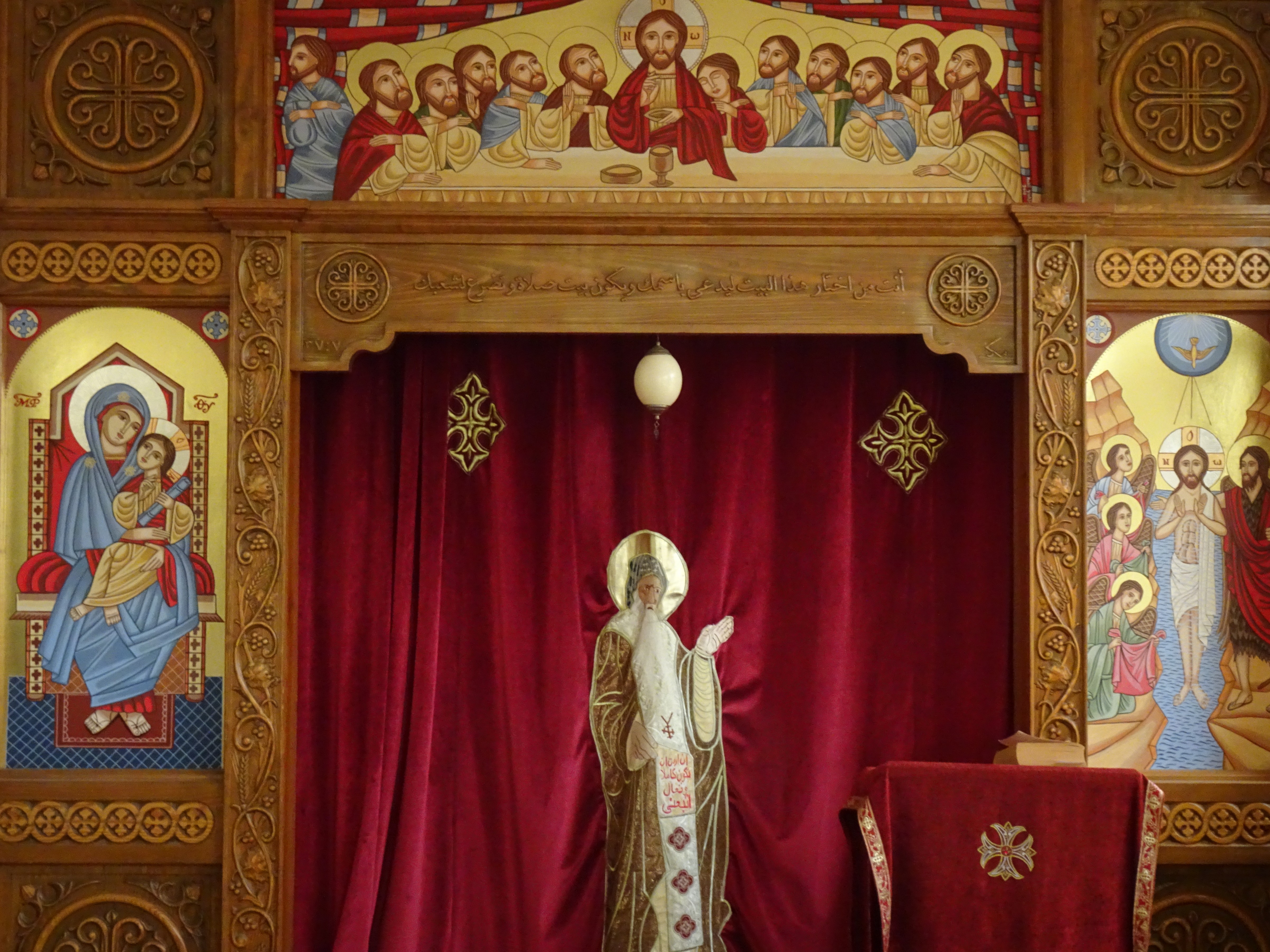
Since I had the gift of spending some time in Egypt with my brother monks in a Coptic Benedictine monastery, I was able to experience our prayer in a different environment. I stood and prayed in front of an iconostasis.
Normally, in our Latin-Western tradition, everything is open. You can see the altar. You can see the sanctuary. But this is not the case in the Eastern churches. The iconostasis blocks the view of the altar. There is a door or a curtain that can be opened for the Holy Eucharist. Otherwise, you are left standing in front of a wooden wall. This wall is called an iconostasis because it holds many icons.
The first time I prayed this way, I felt a strong impression: God is great. He is always greater than I can ever imagine. You are practically standing before the Unknown. Of course, the icons help you understand and enter into the mystery. Mary, the Mother of God, is there with the child. John the Baptist is present, along with the apostles and other saints. But you realize immediately: these are only “images.” I am aware that, in the Orthodox tradition, an icon is more than just an image. It is a representation of the Holy. But for me, it was liberating to feel that all that I can see, all that I can know, all that I can dream, all that I can fear, all that I can understand, all that I can long for, never fully coincides with who God really is. His greatness is beyond all of it – as the altar here is beyond the curtain.
Getting in touch with His mystery was liberating, freeing. And – unexpectedly – it left me with more hope, more courage, more desire to seek God in my daily life. And isn’t that the truth? We don’t know what tomorrow will bring. Acknowledging that is the best way to live the present.
My God, you are great and wonderful. The saints show us the way. Your only Son Jesus Christ IS the way to you. Help me to let go of all my ideas. Help me to throw myself into the unknown, to throw myself into your wide-open arms. Forgive me this imagination.



 Wilde Monk